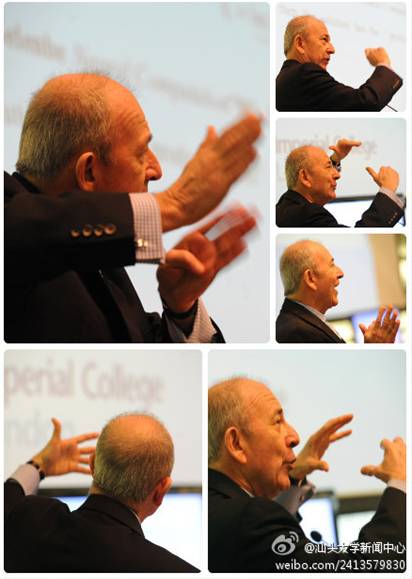
Erol Gelenbe Erol Gelenbe FACM FIEEE FIEE is the Professor in the Dennis Gabor Chair, Electrical and Electronic Engineering Department, Imperial College London. He is a member of the Turkish Academy of Sciences, of Academia Europaea , and of theFrench National Academy of Engineering (Academie des Technologies) . His theoretical research develops and analyses probability models in the computer and information sciences. His group designs self-aware adaptive network protocols such as the Cognitive Packet Network , and tests them via large scale experiments, as part of European research projects on "Autonomic Communications" s upported by the EU FP6 Project CASCADAS and FP7 Project DIESIS. Erol also develops mathematical models of complex systems such as Gene Regulatory Networks, Chemical Reactions, Spiked Neural Networks, and Networked Auctions.

Erol made early research contributions to automata theory and the performance of paging algorithms for virtual memory systems. Then, he and his colleagues showed that random access channels are intrinsically unstable and that they have an explicit optimal stabilising policy; he has contributed the first throughput anayses of data link control procedures; he has developed novel diffusion models of multiprogramming systems and of wireless multi-hop networks; he has proved optimality criteria for checkpointing policies in data bases; he contributed adaptive control policies to avoid thrashing and maximise throughput in virtual memory systems; he has introduced new product form queueing network models that incorporate control functions such as workload re-routing and work removal called
"G-networks". His has introduced models of spiked neurons and their learning algorithms with numerous applications including the design of an "autonomic" packet network (CPN: the cognitive packet network) which uses neural networks in each node for routing decisions. He also investigates equilibria in large agent populations which may have collaborative or adversarial behaviours, as in biology or with software agents. Some of his recent work analyses the time that it takes to "search" when one has imperfect or wrong information about the location of the object that is being sought; this is relevant both to wireless networks, to robotics and to optimisation. A list of Erol's journal papers can be found here. He is a graduate of METU, Ankara, and his publications and collaborations are also listed in DBLP. Erol has supervised over 57 PhD students, many of whom are prominent in academia, industry and government. He is active in funded research programmes in the UK and the EU, and in scientific organisations such as UKCRC and the Informatics Section of Academia Europaea. Erol was a founder of IFIP Working Group 7.3 (Computer System Performance Evaluation), ACM SIGMETRICS and of the journal Performance Evaluation. Since 1986 he has organised with the Turkish computer science and engineering community, the International Symposia on Computer and Information Sciences (ISCIS) which take place every year.

Scientific Awards and Academies:
- ACM SIGMETRICS Life-Time Achievement Award 2008
- French National Academy of Engineering, or Academie des Technologies
- Turkish Academy of Sciences
- Docteur en Sciences "honoris causa" 2006 University of Liege, Belgium , see also here.
- Elected to Academia Europaea 2005
- Honorary PhD 2004 from Bogazici University, Istanbul . Earlier recipients include the Wigner Award winning theoretical physicist Prof. Erdal Inonu and the Chemistry Nobel Laureate Prof. Ahmed Zewail.
- Fellow of ACM (2001) "For advancing computer and network performance evaluation as an international field of research and application, and for establishing national computer science education programs in France".
- Dott. Ing. "honoris causa" in "Ars Computandi" 1996 from Univ. di Roma Tor Vergata, Italy . Later recipients include Andrew Viterbi.
- Prix France Telecom, French Academy of Sciences (1996).
- Science Award of the Parlar Foundation, Turkey (1994).
- Fellow of IEEE (1986) "for leadership in the development of computer system performance evaluation".
- IFIP Silver Core (1980). Honorary Societies Sigma Xi (Science), Eta Kappa Nu (Electrical Engineering) and Upsilon Pi Epsilon (Computer Science).
Honours:
- Grande Ufficiale dell'Ordine della Stella della Solidarieta (2007), Italy
- Commendatore al Merito della Repubblica Italiana (2005)
- Chevalier (1992) and Officier (2001) de l'Ordre National du Merite, Chevalier (2003) de l'Ordre des Palmes Academiques (France)
Editorial Boards: Acta Informatica, Proceedings Royal Society A , The Computer Journal (British Computer Society) , Performance Evaluation, Computational Management Science, Operations Research , Annales des Telecommunications, etc.
A founder of the field of computer system performance and network performance analysis he has published four books which have appeared in English, French, Japanese and Korean. His contributions to system performance evaluation include the introduction of Diffusion Approximations with adhesive boundaries and jumps (Journal ACM '75) to better approximate system performance at light and medium traffic ranges, which were used in the design of the Call Admission Control algorithm in IBM's N-way Stwitch for ATM networks (US Patent 2000), the first proof of the instability of random access communication channels and the design of a feedback control which stabilises and optimises their performance , the computation of optimal checkpointing times in database systems so as to maximise their availability in the presence of unpredictable failures, the invention of new queueing networks with "negative customers" which destroy work when they enter a queue (Journal Appl. Prob. '91) , showing that they have product form solutions, that the destruction of customers in these networks can have a "batch" form while the product form solution is preserved, and introducing new customer types such as "triggers" which displace customers between parts of the network. Thus "negative customers" are control signals that reduce congestion by destroying traffic in selected parts of the network, while "triggers" are signals which balance traffic in the network. Erol has introduced biologically inspired spiked and recurrent neural network models and learning algorithms and has shown that they have product form solutions. These models have proved useful in applications to texture recognition, combinatorial optimisation, to the modeling of neuronal sub-systems in animals and for the control of packet networks. Other recent work includes agent based simulation in conjunction with synthetic environments and augmented reality. He started and lead the Performance Modeling Groups at INRIA (France) (1972-1982).

Erol currently has three main research projects :
(1) Self-Aware Networks and Quality of Service investigates the use of neural networks together with biologically inspired techniques such as reinforcement learning and genetic algorithms, to control network behavior in real-time so as to provide users with the QoS that they request, and to improve network provide robustness and resilience. We are currently experimenting with these ideas on an 80 node Cognitive Packet Network test-bed at Imperial College. The new EU FP6 Project CASCADAS (2006-2009) on Autonomic Communications (with Telecom Italia and British Telecom) builds on these ideas, which are also being applied to autonomically detect and defend networks from denial-of-service attacks in the framework of the new HYPERION project being conducted jointly with British Telecom and UK MoD. We are also working on sensor networks in the framework of the new US/UK International Technology Alliance (2006-2016).
(2) Future Data Fusion Systems (2003-2009) is part of the Defence Technology Centre on Data and Information Fusion, and is supported by UK MoD and General Dynamics UK Ltd.
(3) Distributed Data and Information Systems (2005-2010)is a 5-year EPSRC funded project in collaboration with the Universities of Southampton, Oxford, Bristol and BAE Systems in which our group develops stochastic models of agents to study their equilibrium behaviour and system wide performance.

Recent keynote papers include:
- "Measurement, modelling and simulation of a Cognitive Packet Network" at the 15th Applied Simulation and Modelling (ASM 2006) International Conference on 26-28 June 2006, Rhodes.
- IEEE Computer Society and Information Society of Japan's International Symposium on Applications of the Internet (SAINT2006) in Phoenix, Arizona, January 23-27, 2006. He also presented a keynote on "Keeping viruses under control" at the 20th ISCIS Conference Istanbul, October 28-30, 2005.
- Keynote Paper at the Asian Internet Engineering Conference 2005 in Bangkok, December 13-15, 2005.
- : "Research and development test-beds for future networks" at the Tridentcom Conference on Network Test-Beds, Trento (IT), February 23-25, 2005.
- "Users and services in intelligent networks" at the IEEE/Euro-NGI (Next Generation Internet) Conference in Rome, April 18-19, 2005, at the Networks 2005 conference in Waterloo, Canada .
Our research team includes Dr. Georgios Loukas, Dr. Ricardo Lent, Avgostinos Flippoupolitis, Peixiang Liu, Dr Gulay Oke, Georgia Sakellari, Kumaara Velan. Dr Pu Su received her PhD at UCF and joined Microsoft.
We collaborate with Dr Javier Barria and Prof. Richard Vinter at Imperial.
* In 2005, 2006, 2007 Erol served on the following conference Programme Committees: (1) IEEE International Conference on Pervasive Services (ICPS'07), (2) IEEE/IFIP 3rd EURO NGI conference "2007 Next Generation Internet Networks". (3) Co-Chair International Conference on Adhoc Networks and Information Processing, Bangalore, India, 2007. (4) 2007 ACS/IEEE International Conference on Computer Systems and Applications (AICCSA2007) , (5) IWAN 2006, 25-29 September 2006 in Paris, France, organised by France Telecom (6) IEEE International Conference on Pervasive Services (ICPS) 2005, (7) IEEE/ACM/IFIP 13th International Workshop on Quality of Service (IWQoS) 2005 , (8) 4th International Conference on Autonomous Agents and Multi Agent Systems 2005 , (9) 24th International Symposium on Computer Performance, Modeling, Measurement and Evaluation 2005 , (10) IWAN 2005 (11) 20th International Symposium on Computer and Information Sciences , (12) The Neural Networks Special Track at FLAIRS-19.
* His prior support in the US during 1998-2003 exceeded $4.3M as PI or Co-PI from ARO, NSF, ONR, Lucent Technologies, Adaptec, Giganet Technologies, Schwartz Electro-Optics, Stricom/PEOSTRI and NAWC.

Erol's journal papers have appeared in JACM, CACM, Information and Control, IEEE Trans. on Computers, Proceedings of the IEEE, IEEE Trans. on Software Eng'g., Acta Informatica, J. Applied Probability, IEEE Trans. Comm. Tech., IEEE Trans. on Neural Networks, Neural Computation, SIAM J. Computing, Management Science, IEEE J. on Sel. Areas in Comms., Theoretical Computer Science, Performance Evaluation, European J. of Operations Res., etc. His four authored or co-authored books have been published in French, English, Japanese and Korean.
Professional Awards:
The Silver Core Award of the International Federation of Information Processing Societies (1980) given to a number of IT scientists or professionals world wide every three years (1980 recipients included J.L. Lions, A.P. Ershov, G.I. Marchuk, W.J. Karplus, K. Samelson, F.H. Sumner). Elected membership of Eta Kappa Nu (Electrical Eng'g Honour Society) and Upsilon Pi Epsilon (Computer Science Honour Society). Meritorious Service Award of the IEEE (1989), and Meritorious Service Award of the IEEE Computer Society (1992).
Fellowships: Fulbright Fellow (from Turkey to the USA 1966-67) and NATO Science Fellow (1967-69) as a graduate student (1966-67), Gordon McKay Fellow at Harvard (1974).

Contributions: In the 1970's he designed virtual memory algorithms based on on-line adaptation from system measurements and provided some of the first exact analyses of page fault rates from program models. In the late 70's he co-authored the first analysis of Level 3 network protocols and the first exact proof of stability/instability of random access protocols; then his group designed and built the first fiber-optics random access network (XANTHOS) based on these access control algorithms. He patented a mini-packet based multi-processor switching fabric (SYCOMORE) which was built by the company LMT. He consulted for CNET (France) and helped France Telecom enhance its tele-traffic research activities by showing that traffic models could be effectively used to evaluate the performance. He also introduced diffusion approximations for queueing systems with holding times at the boundaries to improve approximation accuracy at both low and high traffic rates; this analysis was later used in a 1999 IBM U.S. Patent on Call Admission Control in ATM Networks. He was founding Vice-Chair of IFIP WG7.3 (Computer System Modelling and Performance Evaluation) and later served as its Vice-Chair and Chair for two separate six-year terms. He was also a co-founder of ACM SIGMETRICS and was active in ACM SIGOPS.
- In the 80's he published several books on computer performance evaluation , and wrote seminal papers on database performance including optimum checkpointing for reliability, resequencing of out-of-order updates, and analysis of the cost of relational operations. He served in Government from 1982 to 1986, but also graduated many PhD students and worked in the EU ESPRIT QMIPS project. He lectured at Ecole Polytechnique (1979-87), and Chaired the IEEE French Computer Society Chapter from 1981 to 1989.
- In the 90's, motivated by the spiking behaviour of natural neuronal systems, he introduced mathematical models for spiked recurrent random neural networks, developed their learning algorithms, and applied them to problems in image and video processing, object recognition, and on-line system adaptation. He proved that long-term properties of genetic algorithms can be computed in closed form. He invented new queueing networks with negative customers , and extended them to the case of signals and batch customer removal and to triggers and resets, he initiated the EU ESPRIT Project QMIPS (Quantitative Models of Information Processing Systems), and worked on the EPOCH and LYDIA projects. He showed that these queueing models, that are now known as G-networks , have "product form". In the 90's he was also awarded two U.S. patents, one for texture based image recognition and segmentation, and another for an ATM Network Call Admission Control (CAC) algorithm.
- More recently he introduced a Quality of Service (QoS) based "cognitive packet network" routing algorithm which has been implemented in wired and ad hoc wireless test-beds. He also works on QoS theory. He continues his research in queueing networks with product form , develops stochastic models of neural networks , and advanced simulation methods.

Brief Biography (Click for full CV): Erol graduated B.S. High Honours from METU (Ankara) where he won the K.K. Clarke Award (1966) for Undergraduate Research. He completed his MS and PhD (1966-69) as a Fulbright Fellow, then NATO Science Fellow, at Brooklyn Poly , after which he was an Asst. Prof. at the University of Michigan (1970-74), on leave (1972-74) at IRIA, France.
- Erol was awarded the Doctorat d'Etat es Sciences (D.Sc.) from Universite' Pierre et Marie Curie (Paris VI) in 1973. He was appointed Visiting Lecturer (Maitre de conference associe') at Universite' Paris-Nord in October 1973, then to a Chair of Computer Science at the Universite' de Liege (Belgium) in 1974, and Professor (Professeur de 1ere classe) at Universite' Paris Orsay in 1981 where he helped start the Computer Science Graduate Program (DEA) and the Computer Science Department.
- He has taught a broad range of courses in Computer Science and Engineering, including Switching, Automata and Language Theory, Discrete Mathematics, Systems Performance Evaluation, Operating Systems, Computer Architecture, Computer Networks, Probability and Statistics and Neural Computation.
- In 1982-84 Erol proposed, implemented and coordinated the "Programme VFI (Volontaires pour la Formation a` l'Informatique)" in France which ran till the late the 80's, allowing some 2000 graduate engineers and computer scientists to provide IT training to over 20,000 unemployed youths in France.
- He served as Science and Technology Adviser to the French University Minister in 1984-86 where, as part of his duties, he was instrumental in introducing Computer Science Education for all beginning French University and Grande Ecole students (circa 200,000 at that time) including the funding of appropriate equipment and the development of specific curricula. In the Fall of 1986 he was on sabbatical at Columbia University (NYC).
- From 1986 to 1993 he was on the faculty of Universite' Paris V where he started the Computer Science Department, consulted for ONERA (France), NASA-Ames and IBM Research, and participated in ESPRIT Projects QMIPS, and LYDIA, EPOCH together with Siemens and ICL, and in the CNRS-C3 programme. In France he rose to the highest professorial rank of Professeur classe exceptionnelle, 2e` echelon.
- He was the New Jersey State Sponsored Chair of Computer Science at N.J. Institute of Technology (1991-92) on sabbatical leave from the Univ. of Paris V, and joined Duke University (1993-98) where he held the Nello L. Teer Jr. Endowed Chair and chaired the Department of Electrical and Computer Engineering. While at Duke he graduated 7 PhD students and received research grants from ARO, NSF, ONR, DARPA and IBM.
- At the University of Central Florida, Orlando (1998-2003) he was University Chair Professor , Director of the School of Electrical Engineering and Computer Science, and Associate Dean of Engineering. From 1998 to 2003 he served as Member, and then Chair of the Technical Advisory Board of DoD's STRICOM, now PEOSTRI (Simulation, Training and Instrumentation). At UCF he graduated 5 PhD students and was PI or Co-PI of over $4.5M in U.S. federal and industry grants from DoD, NSF and industry.

Biography in: Who's Who (WW) in France, WW in the World, WW in Science and Engineering, WW in America, WW in Medicine and Healthcare, WW in Turkey.

Keynote Papers (2000-05) on Network QoS, Queueing Networks, Neural Networks, and Advanced Simulation Methods :
- E. Gelenbe "Title TBA" Asian Internet Engineering Conference, 13-15 Dec 2005, Bangkok
- E. Gelenbe "User Cooperation and Autonomy in Autonomic Networks" Networking 2005 , 3-5 May 2005, Waterloo, CA
- E. Gelenbe "Fast learning with random neural networks", Keynote Paper, ISCIS'04 -- 19th Int'l. Symposium on Computer and Information Sciences, Springer LNCS 3280, pp. 1-10, Oct. 2004.
- E. Gelenbe "On stability problems for G-networks", Opening Plenary, 14th Int'l. Seminar on Stability Problems for Stochastic Models (Latvian Academy of Sciences, Steklov Math. Institute and Moscow State Univ.), Jurmala, Latvia, Sep. 10-17, 2004.
- E. Gelenbe "Distributed neural network control of packet networks", Keynote Lecture, TAINN04 International, June 10-11, 2004, Foca (Izmir), Turkey
- E. Gelenbe "Fast adaptation with random neural networks", Keynote Lecture, FLAIRS 2004, May 17-19, 2004, Miami, FL.
- E. Gelenbe "Experiments in self-aware networks", Opening Address, ISCIS'03, 18th Int'l. Symposium on Computer and Information Sciences, Springer LNCS 2869, pp. 1-8, Oct. 2003.
- E. Gelenbe
"Applications of spiked recurrent stochastic networks", Keynote Paper, ICANN'03/ICONIP'03, Joint 13th Int'l. Conference on Artificial Neural Networks and 10th International Conference on Neural Information Processing, Istanbul, June 26-29, 2003.
- E. Gelenbe
"Spiked random neural networks, product forms, learning and approximation", Principal Keynote Lecture, Conference on Analytical and Stochastic Modeling Techniques and Applications, European Simulation Multiconference, Norringham, UK, June 9-11, 2003.
- E. Gelenbe, M. Gellman, Pu Su
"Self-awareness and adaptivity for QoS" Invited Paper, ISCC'03, IEEE Int'l Symp. on Comp. and Comm. (IEEE Computer Society), pp. 3-9, June 30-July 3, 2003.
- E. Gelenbe, R. Lent, A. Montuori, Z. Xu "Cognitive packet networks: QoS and performance", Opening Keynote Paper, IEEE MASCOTS'02 Conference (IEEE Computer Society), Ft. Worth, TX, pp. 3-12, Oct. 2002.
- E. Gelenbe, R. Lent, A. Montuori, Z. Xu "Towards networks with cognitive packets", Opening Invited Paper, Proc. Int'l. Conf. on Performance and QoS of Next Generation Networking, Nagoya, Japan, in K. Goto, T. Hasegawa, H. Takagi, Y. Takahashi (eds.), pp. 3-17, Springer Verlag, Nov. 2002.
- E. Gelenbe, K. Hussain, V. Kaptan "Augmented reality with learning agents", Opening Invited Paper, GAME-ON'01, 2nd Int'l. Conf. on Intelligent Games and Simulation (Society for Computer Simulation), pp. XVII-XXVII, London, Dec. 2001.
- E. Gelenbe "Networks with cognitive packet networks", Opening Keynote Paper, IEEE MASCOTS'00 Conference (IEEE Computer Society), San Francisco, CA, pp. 3-12, Oct. 2000.
- E. Gelenbe "G-Networks: Modeling and simulation of networks with control", Keynote paper, Symposium on Performance Evaluation of Computer and Telecommunication Systems (SPECTS 2000), Society for Computer Simulation, Vancouver, July 16-20, 2000.
- E. Gelenbe, C. Cramer "Response of cortico-thalamic oscillations to somatosensory input", Keynote paper, TAINN02 Turkish Artificial Intelligence and Neural Networks Symposium, June 20-23, Izmir, Turkey.

Selected publications:
Network Quality of Service, Wireless Ad Hoc Networks --
- E. Gelenbe, R. Lent, A. Nunez "Self-aware networks and QoS", Proceedings of the IEEE, Vol. 92 (9), pp. 1478-1489, Sep. 2004.
- E. Gelenbe, R. Lent "Power-aware ad hoc cognitive packet networks", Ad Hoc Networks Journal, Vol. 2 (3), pp. 205-216, 2004.
- E. Gelenbe, M. Gellman, R. Lent, P. Liu, Pu Su "Autonomous smart routing for network QoS", Proc. First International Conference on Autonomic Computing (IEEE Computer Society), ISBN 0-7695-2114-2, pp. 232-239, May 17-18, 2004, New York.
- E. Gelenbe, R. Lent, A. Nunez "Smart WWW traffic balancing", Proc. IEEE Comm. Society Workshop on IP Operations and Management, ISBN-7803-8199-8, pp. 15-22, Kansas City, MO, Oct. 1-3, 2003.
- E. Gelenbe, R. Lent, Z. Xhu "Measurement and performance of a cognitive packet network", Journal of Computer Networks Vol. 37, pp 691-791, 2001.
- C. Cramer, E. Gelenbe "Video quality and traffic QoS in learning based sub-sampled and receiver-interpolated video sequences", IEEE J. Selected Areas in Comm. Vol. 18 (2), pp 150-167, 2000.
- E. Gelenbe, P. Kammerman, T. Lam "Performance considerations in totally mobile wireless", Performance Evaluation Vol. 36-37, pp 387-399, 1999.
- E. Gelenbe, A. Ghanwani "Approximate analysis of coupled queueing in ATM networks", IEEE Comm. Letters Vol. 3 (2), pp 31-33, 1999.
- E. Gelenbe, M. Sungur, C. Cramer, P. Gelenbe "Traffic and video quality with adaptive neural compression", Multimedia Systems (ACM/Springer) Vol. 4 pp 357-369, 1996.
- E. Gelenbe, X. Mang, R. Onvural "Diffusion based statistical call admission control in ATM", Performance Evaluation Vol. 27, 28, pp 411-436, 1996.

Computer System Performance Evaluation and Product Form Queueing Networks --
Theory
- E. Gelenbe "Sensible decisions based on Quality of Service", Computational Management Science Vol. 1 (1), pp 1-18 (2004).
- J.M. Fourneau, E. Gelenbe "Flow equivalence and stochastic equivalence in G-networks" , Computational Management Science, Vol. 1 (2), pp. 179-192, 2004.
- E. Gelenbe, J.M. Fourneau "G-Networks with resets", Performance Evaluation, Vol. 49, pp 171-191, 2002.
- E. Gelenbe, R. Schassberger "Stability of product form G-networks", Probability in the Engineering and Informational Sciences Vol. 6, pp 271-276, 1992.
- E. Gelenbe "Product-form queueing networks with negative and positive customers", J. Appl. Prob. Vol. 28, pp 656-663, 1991.
Applications
- E. Gelenbe, Y. Wang "A trade-off between agility and resilience", Proceedings 13th TAINN, pp. 209-218, Dokuz Eylul University, (Turkey), 2004.
- E. Gelenbe, Q. Zhu "Adaptive control of pre-fetching", Performance Evaluation Vol. 46, pp 177-192, 2001.

Neural Networks and Machine Learning --
Theory:
- E. Gelenbe, Z.-H. Mao, Y. Da-Li "Function approximation by random neural networks with a bounded number of layers", J. Differential Equations and Dynamical Systems, Vol. 12 (1 and 2), pp. 143-170, 2004.
- E. Gelenbe, K. Hussain "Learning in the multiple class random neural network", IEEE Trans. Neural Nets., Vol. 13 (6), pp. 1257-1267, 2002.
- E. Gelenbe, Z.H. Mao, Y.D. Li "Function approximation with spiked random networks", IEEE Trans. Neural Networks, Vol. 10 (1), pp. 3-9, 1999.
- E. Gelenbe, J.M. Fourneau "Random neural networks with multiple classes of signals", Neural Computation, Vol. 11 (4), pp 953-963, 1999.
- E. Gelenbe, C. Cramer "Oscillatory corthico-thalamic response to somatosensory input", Biosystems 48 (1-3), pp 67-75, 1998.
- E. Gelenbe
"Learning in the recurrent random neural network", Neural Computation, Vol. 5, pp 154-164, 1993.
Applied Machine Learning:
- M. Georgiopoulos, J. Castro, E. Gelenbe, R. DeMara, A. Gonzalez, M. Kysilka, M. Mollaghasemi, A. Wu, "CRCD Experiences at the University of Central Florida: An NSF Project", ASEE 2004 Annual Conference and Exposition, June 20-23, 2004, Salt Lake City, Utah.
- E. Gelenbe, V. Kaptan, K. Hussain "Simulating autonomous agents in augmented reality", J. Software and Systems, Vol. 74, 255-268, 2005.
- E. Gelenbe, T. Kocak, R. Wang "Wafer surface reconstruction from top-down scanning electron microscope images", Micro-Electronic Engineering,Vol. 75, 216-233, 2004. Slides .
- E. Gelenbe, E. Seref, Z. Xu "Simulation with learning agents", Proceedings of the IEEE, Vol. 89 (2), 148-157, 2001.
- E. Gelenbe, K. Harmanci, J. Krolik "Learning neural networks for detection and classification of synchronous recurrent transient signals", Signal Processing 64 (3), pp 233-247, 1998.
- E. Gelenbe, Y. Feng, K.R.R. Krishnan "Neural network methods for volumetric magnetic resonance imaging of the human brain", Proceedings of the IEEE Vol. 84 (10), pp 1488-1496, 1996.

Books: * E. Gelenbe, G. Pujolle "Introduction to Queueing Networks", Second Edition (including three additional chapters) J. Wiley & Sons, Chichester and New York, 2nd Edition, 1998, 2nd Edition -- 2nd Printing 1999. In other languages: French version ``Introduction aux Reseaux de Files d'Attente'' Collection Scientifique et technique du CNET and Editions Eyrolles (Paris), 1982, Korean Version, Cheong Moon Gak Publishers, Seoul, Korea 2000.
* E. Gelenbe, I. Mitrani ``Analysis and synthesis of computer systems'', Academic Press (London and New York), 1980. Japanese translation: Ohm-Sha Publishing Co., Tokyo 1988.
* E. Gelenbe, ``Multiprocessor performance'', John Wiley & Sons, Chichester and New York, 1989.
* W. Cellary, E. Gelenbe, J. Morzy "Concurrency control in distributed databases", North-Holland Pub. Co., Amsterdam, 1988.
* P. Bouchet, M. Damestoy, E. Gelenbe, Ch. Parent "Procedures de reprise dans les bases de donnees centralisees", Monographie AFCET, Editions Hommes et Techniques, Paris, 1978.
* E. Gelenbe, R. Marie, M. Metivier, J. Labetoulle, G. Pujolle, W. Stewart "Methodes de modelisation de systemes informatiques", Monographie AFCET Editions Hommes et Techniques, Paris, 1980.

He is an Associate Editor of several journals including Acta Informatica, The Computer Journal (BCS, UK), Telecommunication Systems, Performance Evaluation, Journal de Recherche Operationnelle (France), Annales des Telecommunications (France), Simulation Practice and Theory, and Communication Systems. Previously he has served as Associate Editor of Proceedings of the IEEE, IEEE Transactions on Software Engineering, Revue d'Informatique de l'AFCET (France), Information Sciences and Alta Frequenza (Italy).

E-mail: E-mail

Ph.D. Graduates (First degree from, Year of PhD, Current Affiliation): Hossam Abdelbaki (Univ. Alexandria, 2000, Asst. Prof. of Electrical Engineering, Univ. of Alexandria, Egypt), Sophie Chabridon (1996, INT, France), Alexandre Aussem (INT, 1995, University of Clermont Ferrand), Volkan Atalay (METU, METU, Ankara), Francois Baccelli (ENST, INRIA & Ecole Normale Superieure, Paris), Sophie Barbaroux (ENS Cachan, 1992, CIV, Sophia Antipolis), Guy Bernard (Ecole Centrale, INT, Evry, France), Jose Aguilar Castro (Univ. Merida, Venezuela, 1995, Univ. Houston), Alain Chesnais (ENS Cachan, ATI Inc. and former President of SIGGRAPH), Chris Cramer (LSU, Baton Rouge, LA, 1998, Assistant Professor of Electrical and Computer Engineering, Duke University), Andrzej Duda (1984, Univ. Grenoble), Yutao Feng (Univ. Beijing, 1997, C-Cube Microsystems), Mahmoud El Dessouky (Cairo University, Consultant, Cairo, Egypt), Jean-Michel Feuvre (ENS Cachan, 1981, Consultant, France), Jean-Michel Fourneau (ENSAE, PRISM, University of Versailles, France), Anoop Ghanwani (1998, HP Labs, CA), Alain Jean-Marie (ENS St Cloud, INRIA and University of Montpellier, France), Genevieve Jomier (Univ. Nancy, Univ. Paris-Dauphine), Alain Kurinckx (Univ. Liege, THALES, France), Ali Labed (1998, Nortel, Toronto), Jacques Lenfant (ENS St Cloud, Univ. Rennes I), Xiaowen Mang (BUPT, Beijing, 1996, AT&T Labs, NJ), Dominique Potier (Ecole Centrale, THALES, France), Banh Tri An (Univ. Liege, Univ. Liege, Belgium), Jacques Labetoulle (Ecole Centrale, Ecole de l'Internet, Marseilles, France), Zhen Liu (Beijing Univ., 1989, IBM Research Center, Yorktown Heights, NY), Eric Horlait (Univ. Amiens, Univ. Paris VI), Philippe Nain (INRIA, Sophia Antipolis, France), Noufissa Mikou (ENS Fontenay, Univ. Bourgogne, Dijon), Ferhan Pekergin (Istanbul Tech. Univ., Univ. Paris-Nord, France), Nihal Pekergin (Istanbul Tech. Univ., Univ. Paris-Sorbonne, France), Guy Pujolle (Univ. Paris IX, Univ. Paris VI), Marisela Hernandez Perez (Univ. Caracas, 1990, Univ. Amiens), Brigitte Plateau (ENS Fontenay, INRIA and Univ. de Grenoble, France), Jean-Marc Vincent (ENS St Cloud, 1990, Univ. de Grenoble, France), Catherine Rosenberg (ENSTB, Purdue University, West Lafayette, Indiana), Andreas Stafylopatis (NTUA, National Technical University, Athens, Greece), Salvatore Tucci (Univ. Pisa, University of Rome II, Italy), Yoram Haddad (ENSAE, 1988), Christine Soula, Jean Vicard (Univ. Paris-Nord), Ricardo Lent (Univ. Ricardo Palma, Peru, 2003, Visiting Assistant Professor, UCF), Qi Zhu (2002, Assistant Professor Florida Gulf Coast University), Zhiguang Xu (BUPT, Beijing, 2001, Assistant Professor, Valdosta State University, GA), Khaled Hussain (Univ. Assiout, Egypt, 2001, Visiting Assistant Professor, UCF), Taskin Kocak (Bogazici Univ., Istanbul, 2001, Asst. Prof. of Computer Engineering, UCF), Vijay Srinivasan (1995, Cosine Networks, Redwood City, CA), Myriam Mokhtari (Univ. Algiers, 1994, University of Rheims, France), Vassilada Koubi (Greece), Christine Hubert (1995, University of Nantes, France), Rakesh Kushwaha (1993, mFormation Inc., NJ), Jean-Pierre Le Narzul (ENSTB, 1993, ENSTB, France).
Recent M.S. graduates: Rong Wang (2000, Accusoft), Esin Seref (2000, Nortel, Dallas), Jun Wang (1999, Cisco, San Jose), Teresa Lam (1998, Schlumberger, Houston), Patrick Kammerman (1998, Andersen Consulting), Will Washington (1999, IBM Austin, TX), Yonghuan Cao (1998, Duke), George Shih (1997, Duke Medical Center), Hakan Bakircioglu (1997, Lucent Technologies, New Jersey), Samir Kotia (1997, Lucent Technologies, New Jersey). Current Graduate Students: Georgios Loukas, Varol Kaptan, Arturo Nunez, Peixiang Liu, Pu Su, Michael Gellman, Feng Lu, Yu Wang.

Edited Books:
* M. Calzarossa, E. Gelenbe (eds.) "Performance Tools and Applications to Networked Systems", LNCS 2965, Springer Verlag, Berlin and New York, 2004.
* E. Gelenbe, C. Kaiser (ed.) "Operating systems theory and practice", Springer Lecture Notes in Computer Science (Berlin and Heidelberg), 1974.
* E. Gelenbe (ed.), “Advances in System Performance Evaluation”, CRC Press, Boca Raton, 2000.
* E. Gelenbe, K.K. Bagchi, G.W. Zobrist (eds.) “Network Systems Design”", Gordon and Breach, Amsterdam, 1999.
* E. Gelenbe, J. Walrand, G.W. Zobrist, K. Bagchi (eds.) "“Network Systems Design”", Gordon and Breach, Amsterdam, 1998.
* E. Gelenbe (ed.), “"Neural Networks: Advances and Applications II”", North-Holland Pub. Co. (Amsterdam), 1992.
* E. Gelenbe (ed.), “"Neural Networks: Advances and Applications I”", North-Holland Pub. Co. (Amsterdam), 1991.
* E. Gelenbe, R. Mahl, (ed.) “"Computer architectures and networks: modelling and performance evaluation”", North-Holland Pub. Co. (Amsterdam), 1975.
* E. Gelenbe, H. Beilner (eds.) “"Measuring, modelling and evaluating computer systems”", North-Holland Pub. Co. (Amsterdam), 1977.
* M. Arato, A. Butrimenko, E. Gelenbe (ed.) "“Computer system performance”", North-Holland Pub. Co. (Amsterdam), 1978.
* E. Gelenbe, (ed.), “"Distributed systems”", IEEE Press, New York, 1981.
* G. Gardarin, E. Gelenbe (ed.), "New applications of databases”", Academic Press, London and New York, 1984.
* E. Gelenbe, (ed.) "“Performance '84”", North-Holland Pub. Co. (Amsterdam), 1984.
* E. Gelenbe, (ed.) “"High Performance Computer Systems"”, North-Holland Pub. Co. (Amsterdam), 1987.
* J. L. Delhaye, E. Gelenbe “"High Performance Computing”", North-Holland Pub., Co. (Amsterdam), 1989.